Saudi Arabia & Pakistan Defense Pact: An Attack on One Will Be an Attack on Both; A Clause on Nuclear Weapons Included
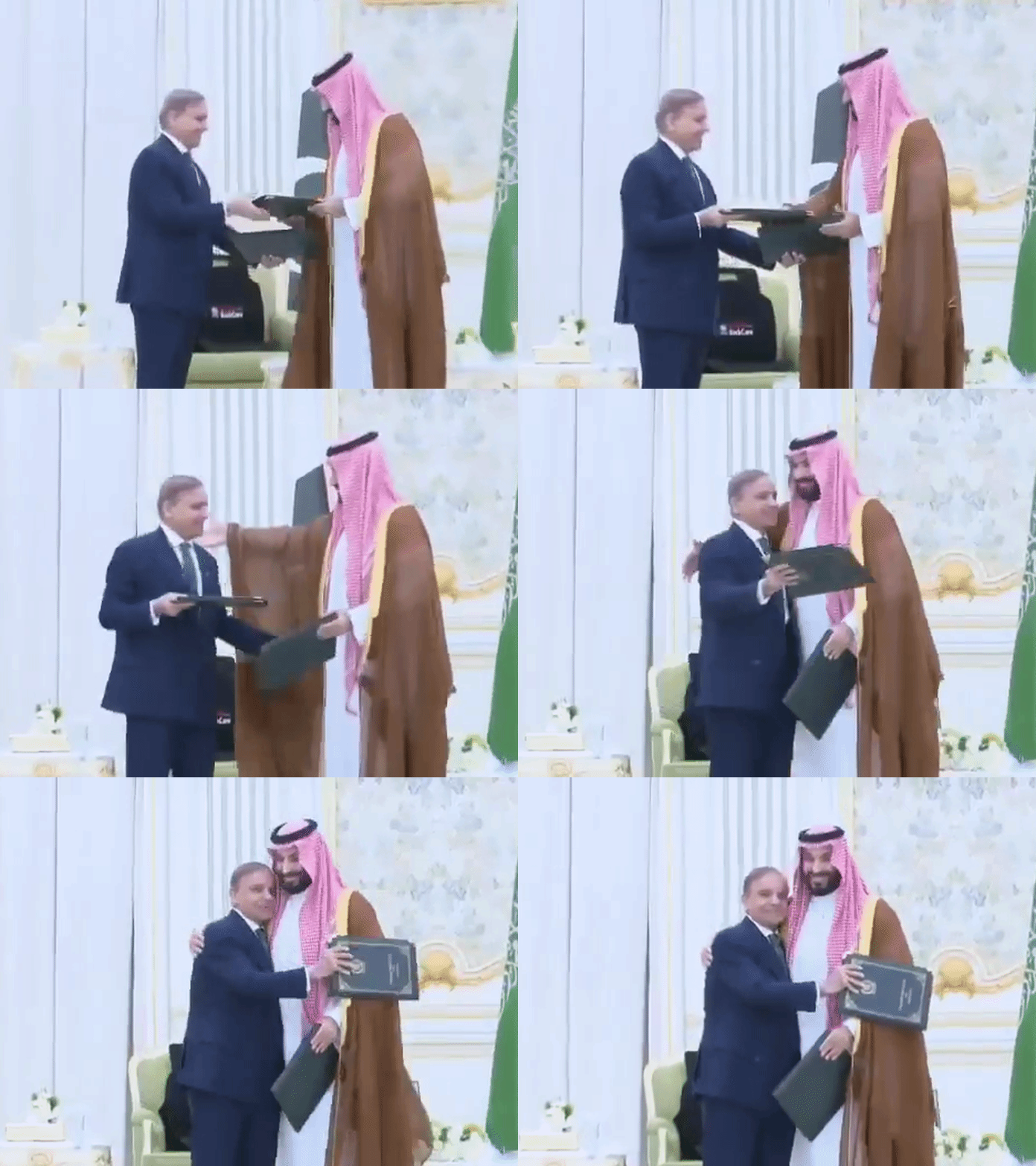
Saudi Arabia’s Crown Prince Mohammed bin Salman (MBS) and Pakistani Prime Minister Shehbaz Sharif have signed a landmark defense agreement. The pact states that an attack on one country will be considered an attack on the other. According to the Saudi Press Agency, both nations issued a joint statement highlighting that this agreement demonstrates their commitment to strengthening security and establishing global peace. The pact will also foster deeper defense cooperation between the two countries.
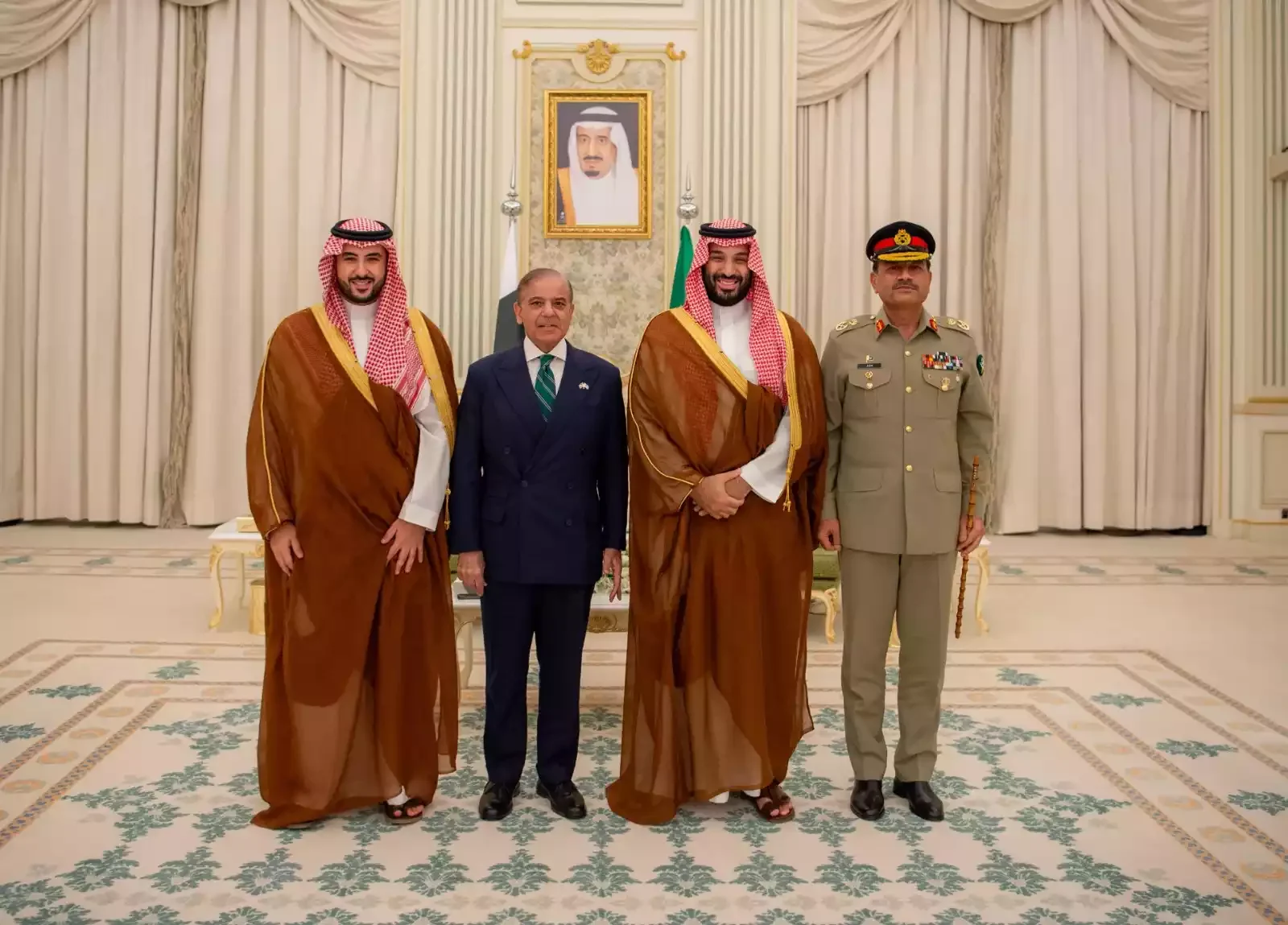
During their meeting at the Yamamah Palace in Riyadh, Crown Prince MBS and Prime Minister Sharif discussed various topics, including regional and international issues. A senior Saudi official, who wished to remain anonymous, told the Reuters news agency that this agreement encompasses all forms of military cooperation. When asked if this includes the use of Pakistan’s nuclear weapons if necessary, the official responded with a definitive ‘yes.’
Pakistan’s Army Chief Was Present During the Signing
Shehbaz Sharif’s high-level delegation to Saudi Arabia included Pakistan’s Army Chief Asim Munir, Deputy Prime Minister Ishaq Dar, Defense Minister Khawaja Asif, and Finance Minister Muhammad Aurangzeb. Pakistan’s Army Chief Asim Munir was present during the signing of this defense agreement.
An official told Reuters that this pact is not directed against any specific country or event. Instead, it is the official formalization of a long-term, deep-seated partnership between the two nations.
Pakistan Recently Proposed a NATO-like Force
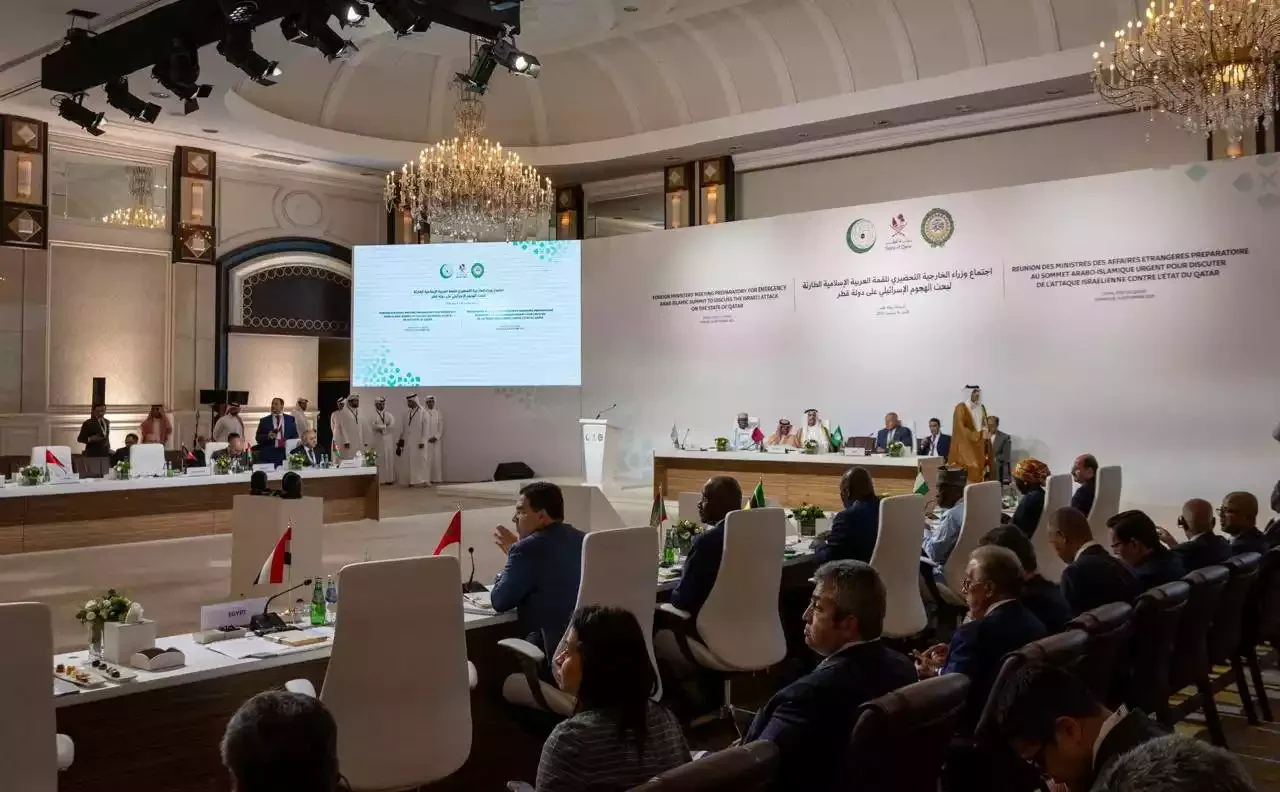
On September 9, Israel launched an attack in Doha, Qatar, targeting Hamas chief Khalil al-Hayya. While al-Hayya survived, six other people were killed. Following this, on September 14, several leaders from Muslim countries gathered for a special meeting in Doha to discuss a response to Israel. It was here that Pakistan suggested creating a joint, NATO-like force for all Islamic nations. Pakistan’s Deputy Prime Minister, Muhammad Ishaq Dar, mentioned the possibility of creating a joint defense force, stating that nuclear-powered Pakistan would fulfill its responsibilities towards the Islamic community (Ummah).
🚨⚡️UNUSUAL
Saudi Arabia and Pakistan have formalized a mutual security treaty. The treaty stipulates that any attack on either country will be considered an attack on both.
This formally legalizes the use of Pakistani nuclear weapons to defend the kingdom.pic.twitter.com/JOc79v2xNQ
— RussiaNews 🇷🇺 (@mog_russEN)September 17, 2025

Experts Weigh In: This Agreement Is Not a Formal ‘Treaty’
Zalmay Khalilzad, a former US Ambassador to Afghanistan and Iraq, also commented on the agreement. He said that while this is not a formal “treaty,” its seriousness makes it a significant strategic partnership. Khalilzad further questioned whether this agreement was a response to the Israeli attack in Qatar or if it confirms long-standing rumors that Saudi Arabia has been an undeclared ally in Pakistan’s nuclear weapons program.
Khalilzad also asked if there were any secret clauses in the agreement and, if so, what they were. He also raised the point that this agreement may indicate that Saudi Arabia no longer wants to rely entirely on America for its security guarantees. He also noted that Pakistan possesses nuclear weapons and missile systems capable of striking targets across the entire Middle East, including Israel. Some reports even suggest that Pakistan is developing weapons that can reach the United States.
MobiKwik का ऐप अपडेट और ₹40 करोड़ का नुकसान, यूजर्स की जेब खाली
A potentially consequential step in Pakistan-Saudi relations has been reportedly been announced, a mutual defense agreement (not on the level of a treaty, but it’s not clear if Saudi Arabia and#Pakistanmake a distinction between a treaty and an agreement) stating that any…
— Zalmay Khalilzad (@realZalmayMK)September 17, 2025



Pakistan Had a Similar Defense Pact with the US
Pakistan had previously entered into a defense agreement with the United States, similar to the one with Saudi Arabia, which was dissolved in 1979. Even before its dissolution, America did not directly assist Pakistan in the two wars it fought with India.
Pakistan-US Old Defense Pact:During the Cold War in the 1950s, the US sought allies in South Asia to counter the expansion of the Soviet Union. Pakistan then adopted a military alliance with the United States.
- Mutual Defense Assistance Agreement (MDAA), May 19, 1954:This was a bilateral agreement between Pakistan and the US. It included provisions for mutual defense, meaning both countries would provide military assistance to each other (including weapons, training, and equipment). The US encouraged Pakistan to participate in collective security efforts, involving Pakistan’s resources, soldiers, and strategic facilities. This agreement was based on the US Mutual Defense Assistance Act of 1949, which provided military aid to allies in Europe and Asia.
- SEATO (1954) and CENTO (1955):Following the MDAA, Pakistan strengthened this alliance by joining the Southeast Asia Treaty Organization (SEATO) and the Baghdad Pact (later CENTO). The articles of these organizations had provisions for a collective response to an attack on any member, treating an attack on one as an attack on all (similar to NATO). Under these agreements, the US provided Pakistan with military aid worth more than 7,000 crores, including weapons and training.
Why the 1979 Agreement Broke Down?
CENTO ended in 1979. Although the MDAA was a bilateral agreement, it was linked to the CENTO framework.
- Iran’s Revolution (1979):Following the downfall of the Shah of Iran and the Islamic Revolution, Iran withdrew from CENTO on March 15, 1979. As Iran was a key member, the organization weakened significantly.
- Pakistan’s Withdrawal:Pakistan also left CENTO on March 12, 1979. The reasons included the Soviet invasion of Afghanistan (December 1979), Pakistan’s non-aligned policy, and fluctuating relations with the US (such as the American sanctions on Pakistan’s nuclear program in 1979).
- US Aid Restrictions:The Jimmy Carter administration halted military aid to Pakistan in 1979 due to its secret uranium enrichment program for nuclear weapons. This effectively ended the alliance.
Even after the agreement, the US did not provide help. CENTO officially ended on March 16, 1979. While US-Pakistan relations later strengthened during the Afghan war (after 1979), the old mutual defense framework was permanently gone.
Before this, in the 1947, 1965, and even 1971 wars, the US did not provide direct military assistance to Pakistan, despite the mutual defense provisions. The US considered these wars to be regional disputes, not a case for collective defense under the alliance. The MDAA/SEATO/CENTO agreements were specifically against Soviet/Communist threats, not against India (which was not part of the bloc). As a result, Pakistan did not receive the expected assistance, which raised questions about the alliance’s effectiveness.

Frequently Asked Questions (FAQs)
What is the new defense pact between Saudi Arabia and Pakistan?
The newdefense agreement, signed in Riyadh, stipulates that an attack on one country will be considered an attack on both. It aims to enhance mutual security and global peace.
Does the Saudi-Pakistan agreement involve nuclear weapons?
A senior Saudi official told Reuters that the pact includes all types of military cooperation, confirming that it could involve the use of Pakistan’s nuclear weapons if needed.
What is the historical context of Pakistan’s defense agreements?
Pakistan previously had a similar defense pact with the United States in 1954, known as the Mutual Defense Assistance Agreement (MDAA), which dissolved in 1979 due to various geopolitical shifts and the collapse of CENTO.

(देश और दुनिया की ताज़ा खबरें सबसे पहले पढ़ेंTalkAaj (Baat Aaj Ki) पर , आप हमें Facebook, Twitter, Instagram और Youtube पर फ़ॉलो करे)